How to Run Reels Trending Ads
Getting an ad into Instagram Reels is straightforward. Getting it next to the Reels that are already attracting attention is a different proposition.
Meta's Reels trending ads are designed for that second use case. Instead of serving across ordinary Reels inventory alone, they let advertisers buy the ad slot immediately after top-trending creator-generated Reels. Advertisers can also steer placement towards particular content categories, giving brands a way to participate in relevant cultural moments without having to predict exactly which individual Reel will take off.
The format has some important constraints. Reels trending ads use reservation buying, support the awareness objective and run only in Reels. They also have their own campaign setup, creative considerations and measurement requirements.
Here is how to plan and run a Reels trending ads campaign without treating it like another standard Instagram ad buy.
What are Reels trending ads?
Reels trending ads are Instagram ads positioned immediately after top-trending Reels content. Meta describes the product as a way for advertisers to place their creative alongside content that is already culturally relevant and receiving attention.
The distinction matters.
With a conventional campaign, an advertiser primarily thinks about who should see the ad. Reels trending ads introduce another consideration: what kind of content should the ad appear next to?
That makes the format particularly relevant to awareness campaigns built around launches, cultural moments, entertainment, fashion, sport, food and other areas where the surrounding conversation can contribute to the message.
Meta's own campaign guidance positions the product around six broad practices: align it with the wider media strategy, keep the relevant audience as large as possible, select appropriate content categories, reserve inventory early, measure brand outcomes and build creative specifically for Reels.
1. Start with the right campaign goal
Before opening Ads Manager, decide what job Reels trending ads are supposed to do.
The format currently supports the awareness objective, and the buying type is reservation rather than auction. The placement is limited to Reels.
That makes this primarily a brand-building format rather than a direct-response campaign that you would optimise around an immediate conversion.
The distinction should influence how you judge performance. Clicks can still be useful information, but if the campaign is designed to increase awareness or recall, evaluating it only by last-click conversions would miss the purpose of the buy.
Meta also recommends considering Reels trending ads as part of a broader strategy rather than automatically running them in isolation. Depending on the goal, its materials suggest combining them with business-as-usual media, Meta Moment Maker or target-frequency activity.
For example, a brand could use trending placement to gain attention around a short-lived cultural moment, then use frequency-focused activity to maintain visibility afterwards.
2. Understand the reservation model before setting the budget
Reels trending ads don't follow the normal auction-buying model that many Meta advertisers are accustomed to.
The format is bought through reservation at a fixed CPM. Meta's campaign checklist specifies a lifetime budget, with the applicable amount communicated by a Meta representative. Campaigns can be booked for flights as short as three days.
Pricing also varies by delivery country. The supplied Meta material lists fixed CPMs in local currencies across 26 supported countries. For India, for example, the listed CPM is ₹30. The US is listed at $15, while the UK is £8. Meta notes that currency conversion can cause some variation when the ad account uses a different currency.
There is another planning implication: inventory isn't something to leave until launch day. Meta advises advertisers to book campaigns early, and its setup documentation says ads can be booked up to 180 days in advance.
For campaigns tied to a known product launch, sporting event, entertainment release or seasonal moment, reservation planning should therefore happen alongside the media plan rather than after the creative is finished.
3. Choose between all trending Reels and topical lineups
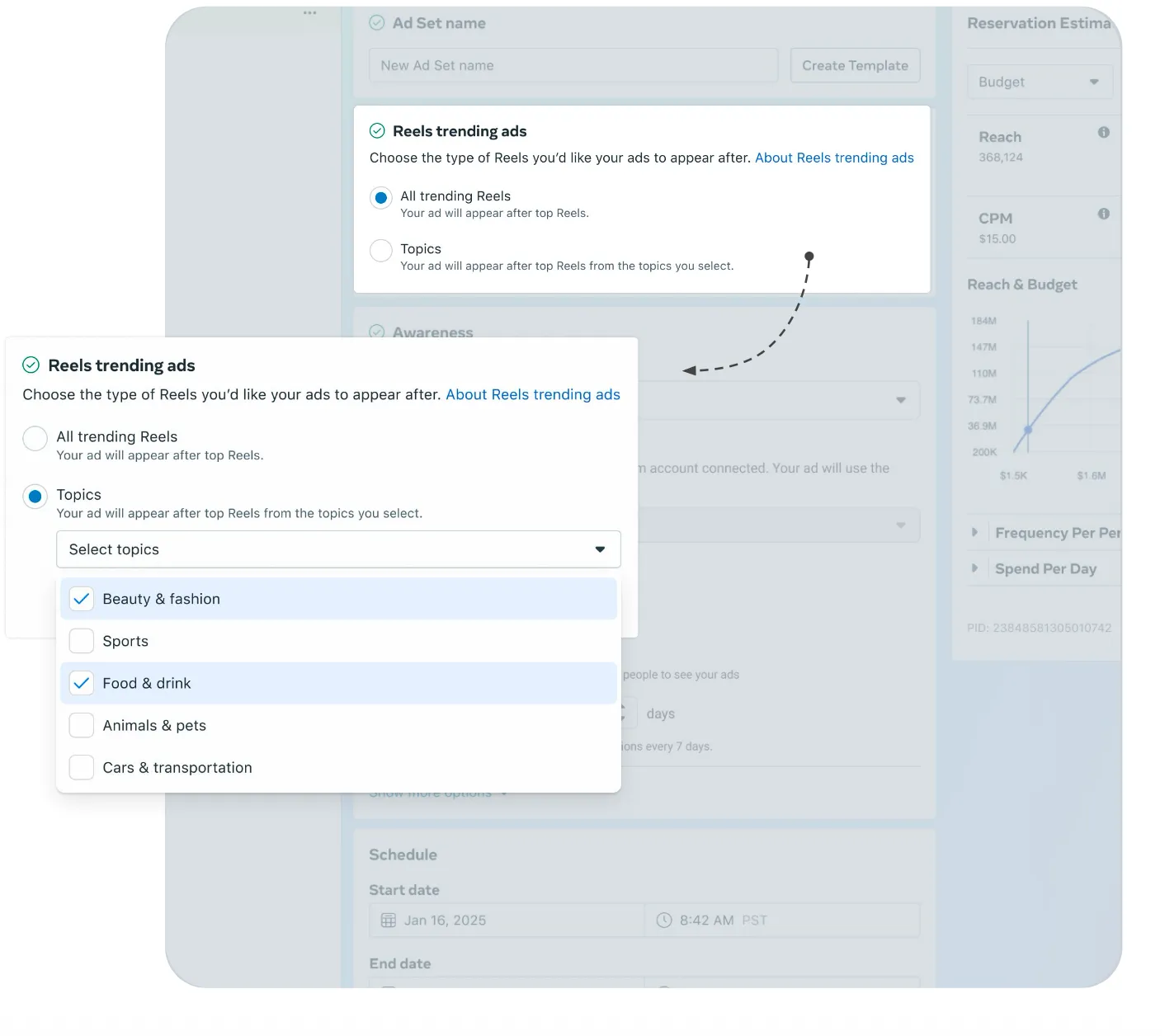
One of the more useful controls in the format is the ability to decide what kind of trending content the campaign should follow.
Meta's setup material describes two basic options:
- All trending Reels: the ad can appear next to top-trending content generally.
- Topic-based targeting: the advertiser selects particular content categories so ads can appear alongside top content relevant to those subjects.
The document lists content categories including animals and pets, beauty and fashion, cars and transportation, food and drink, sports, music, business, finance and investments, travel, and TV and movies.
Don't select every category simply to maximise possible delivery.
Meta's own recommendation is to start with the categories most relevant to the brand and then add general trending content.
A sportswear company launching a running shoe, for example, has a clearer contextual connection to sports content than to every Reel that happens to be trending. A film studio promoting a new release may find TV and movies more useful. The point isn't to make the audience unnecessarily narrow; it is to give the placement a logical connection to what the viewer has just watched.
There is a structural detail to remember during setup. A campaign can contain multiple ad sets targeting different Reels trending topics, but Meta says all trending Reels needs to be booked in a separate ad set from topic-based lineups.
/uploads/1786607227785-Image-13-08-26-at-1.12---PM.webp
4. Keep audience targeting broader than you might expect
Contextual relevance doesn't mean the audience itself needs to become highly restrictive.
Meta specifically recommends choosing the largest possible audience that remains relevant to the business.
That makes sense given what the format is trying to accomplish. The topical lineup already provides one relevance signal through the content surrounding the ad. Layering a long series of audience restrictions on top can work against an awareness campaign's need for reach.
Some demographic and geographic targeting is available. The supplied pricing documentation says state-level targeting is supported. It also states that age or gender targeting beyond the default A18+ setting carries a 10% CPM surcharge.
So audience restrictions shouldn't be added simply because they're available. Ask whether each restriction improves the campaign enough to justify reducing scale or, where applicable, increasing cost.
5. Build the campaign as a dedicated Reels trending ads campaign
Once an eligible ad account has been added to the allowlist, Reels trending ads can be activated with a campaign-level toggle.
Meta describes this as a standalone campaign flow: all ad sets inside that campaign are Reels trending ads-only. Activating the option also enables the content-targeting controls used to select topical lineups.
The core campaign settings from Meta's checklist are:
| Setting | Reels trending ads requirement |
|---|---|
| Buying type | Reservation |
| Objective | Awareness |
| Format | Reels |
| Charging basis | Impressions |
| Delivery | Standard |
| Budget | Lifetime budget |
| Creative | Reels creative following best practices |
Treat those requirements as the starting framework rather than trying to retrofit an existing auction campaign.
[INLINE IMAGE: Insert the campaign-creation/dashboard screenshot from the attached PDF showing the Reels trending ads campaign toggle and reservation setup.]
The campaign can then contain multiple ad sets where different topical strategies need to be separated. This also creates a cleaner structure for comparing lineups rather than mixing every contextual choice into one ad set.
6. Don't treat brand suitability as an afterthought
Appearing near trending user-generated content creates an obvious advertiser concern: a Reel can be popular without necessarily being appropriate for every brand.
Meta says Reels trending ads run with its most stringent brand safety and suitability inventory filter.
The format is therefore designed to combine trend-based placement with tighter suitability controls rather than simply putting an advertiser behind anything generating views.
That distinction is particularly relevant for brands in regulated or reputation-sensitive categories. Cultural relevance is useful only when the context remains acceptable for the brand.
The surrounding content strategy and the brand's own creative still need human judgment, though. A suitability filter addresses one type of risk; it doesn't guarantee that every trending topic will make strategic sense for every advertiser.
[INLINE IMAGE: Use the brand-suitability diagram from the PDF showing the relationship between top-trending Reels, the ad placement and limited-inventory content.]
7. Make the ad feel like it belongs in Reels
Placement can put an advertisement near popular content. It can't make weak creative interesting.
Meta identifies three basic creative essentials for Reels ads: vertical video, audio and keeping important elements within the safe zone.
For Reels trending ads, there is another layer. The creative should make sense in the cultural context the advertiser is buying.
Meta's recommended workflow starts with Instagram's first-party trend insights. Brands can use those signals alongside their own product and content strategy to identify a trend worth participating in. From there, Meta recommends viewing top Reels to understand how the trend is being expressed before developing an in-house, agency or creator brief.
The order is useful. Don't create a conventional brand video first and then search for a trend to attach to it. Study how people are actually participating, decide where the brand has a credible role, and develop the creative from that intersection.
8. Consider creator content when the trend depends on creators
Some cultural moments are difficult for a brand account to reproduce convincingly.
In those cases, creator partnerships can close the gap between media placement and creative execution. Meta recommends evaluating creators with engaged Instagram audiences who can produce content related to the chosen trend. It also recommends using partnership ads to amplify creator content.
The practical advantage isn't simply that a creator appears in the video. A creator who already understands the visual language, pacing and conventions of a trend may be better positioned to produce something that doesn't feel disconnected from the Reels surrounding it.
That doesn't mean every campaign needs a creator. Strong in-house creative can work when the brand naturally understands the format. Creator involvement becomes more valuable when authenticity within a specific community or trend is central to the idea.
9. Give the system enough creative to work with
One video is a thin creative strategy for a short-form environment.
Meta recommends using at least four videos that meet its Reels best practices for a Reels trending ads campaign.
Those variations shouldn't just be four exports of the same execution. Where the campaign concept allows it, test different hooks, openings, creator treatments or ways of communicating the message.
This is particularly useful when the campaign is tied to fast-moving content. What seems like the strongest creative in a storyboard isn't necessarily the version viewers will remember when it sits between two engaging Reels.
10. Measure brand lift, not just delivery
A reservation campaign can tell you whether the planned impressions were delivered. That doesn't tell you whether those impressions changed anything.
Meta explicitly recommends testing the impact of Reels trending ads on brand outcomes.
For advertisers running a brand lift study, its documentation provides a more specific testing framework. The Reels trending ads “child” study should contain only the Reels trending ads campaigns, while the “parent” study should include Reels trending ads plus business-as-usual media.
Meta also recommends:
- at least four Reels-best-practice videos;
- a minimum seven-day Reels trending ads run for the brand-lift test;
- business-as-usual media remaining live for the entire test;
- following the relevant targeting guidance;
- meeting the minimum brand-lift budget requirements; and
- avoiding campaign edits or ending the test early.
There is an important distinction here. Meta's general campaign checklist says Reels trending ads flights can be booked for as little as three days, while the brand-lift testing guidance calls for at least seven days. In other words, a campaign can technically be shorter than the recommended measurement window. If proving incremental brand impact is part of the brief, plan the schedule around the study rather than the minimum possible flight.
What can advertisers reasonably expect?
Meta's published material gives some indication of why advertisers might test the format, although the numbers should be treated as study results rather than guaranteed campaign outcomes.
A cross-vertical statistical meta-analysis covering 59 lift studies reported a 6.6-point incremental ad-recall lift and 1.5x higher ad-recall lift per impression compared with business-as-usual Reach campaigns. A separate Kantar Context Lab study reported a 20% increase in total unaided brand awareness.
Individual campaigns show how widely outcomes can vary.
JCPenney's Meta brand lift study reported 32% higher ad recall and 6x greater favourability for Reels trending ads compared with its business-as-usual ads.
Tropical Smoothie Cafe reported a 13.1-point lift in ad recall, 4.1-point lift in unaided brand awareness and 5.7-point lift in consideration. Its campaign also recorded 22% higher three-second video plays than its usual campaign, according to the case study.
Those results don't mean every advertiser should expect the same lift. Creative quality, category, baseline awareness, audience, campaign duration and the cultural moment itself can all change the outcome. The more useful takeaway is that contextual placement should be tested as an incremental part of the media strategy rather than assumed to work simply because the preceding content is popular.
A practical Reels trending ads launch checklist
Before reserving inventory, make sure the campaign answers these questions:
- Is awareness actually the goal? Reels trending ads currently support the awareness objective.
- What cultural context matters to the brand? Start with the most relevant topical lineups rather than selecting everything.
- Does the campaign need general trending inventory too? If so, structure it in a separate ad set from topic-based lineups.
- Is the audience unnecessarily narrow? Meta recommends maintaining the largest relevant audience.
- Has inventory been reserved early enough? Known tentpole moments should be planned ahead.
- Do you have at least four Reels-ready videos? Build vertically, use audio and keep key information in the safe zone.
- Would a creator make the idea more credible? Consider creator content and partnership ads when the trend calls for it.
- How will success be measured? If brand lift matters, design the test before launch and allow enough time for it to run without disruptive edits. Reels trending ads are most useful when the placement, context and creative work together. Buying the slot after trending content provides the opportunity, but it doesn't remove the need for a clear media objective or a Reel people will actually want to watch.
The stronger approach is to start with a cultural moment that genuinely fits the brand, choose the corresponding content environment, keep audience restrictions proportionate, and build creative for the way people already consume Reels. Then measure whether that contextual advantage produces incremental brand impact rather than assuming proximity to a trend is enough.